Most people would tell you that the main character in the Ramayana is God Ram. When asked which character is the greatest, a large percentage of those people would quietly state Lakshman. Lakshman is the brother who left behind a palace of wealth and power to follow his older brother into the wilderness.
He spent 14 years living as a wanderer in the wild, never getting any real sleep. In addition to being the brother with a short temper, he was also the brother who provided support to his older brother throughout the journey.
Table of Contents
The Ramayana movie will soon be playing in theaters, so many of us will be meeting Lakshman for the first time on a really large screen. Many of us were introduced to Lakshman through Ramanand Sagar’s television series, others heard about him through bedtime stories told by their grandparents, and some of us are getting to know Lakshman almost entirely for the first time.
In this guide, we’re going to tell you who Lakshman is, what role he plays in the Ramayana, how much more important he actually is than he has traditionally been given credit for, and who plays Lakshman in the Ramayana movie.
About the Ramayana Movie
The Ramayana will feature Ranbir Kapoor as Ram, Yash as Ravan, Sai Pallavi as Sita, Ravi Dubey as Lakshman, and Sunny Deol as Hanuman. The first installment of the film is scheduled to be released in India and internationally on November 5th, 2026. A second installment of the film is slated for release during Diwali 2027.
As a whole, the story of Lakshman’s life is quite long. Some parts of his life (particularly those that occur after the midpoint of the story) will likely not appear in the first film.
Therefore, I will indicate where the different stages of Lakshman’s journey occur, and whether they are represented in the first or second film. That way, you will understand why the film appears to skip over certain portions of his life.
Who Lakshman Is: Birth and Background
Lakshman (or Laxman, Lakshmana, or Laksman) was the second son of King Dasharatha of Ayodhya and Queen Sumitra. He was the twin of Shatrughna and the half-brother of Ram and Bharata, both of whom were the sons of Kaushalya and Kaikeyi, respectively.
The story behind his birth should be understood. Dasharatha did not have any children; therefore, he performed a sacred fire ceremony and distributed a holy food item known as payasam (sweet rice pudding) to each of his three wives.
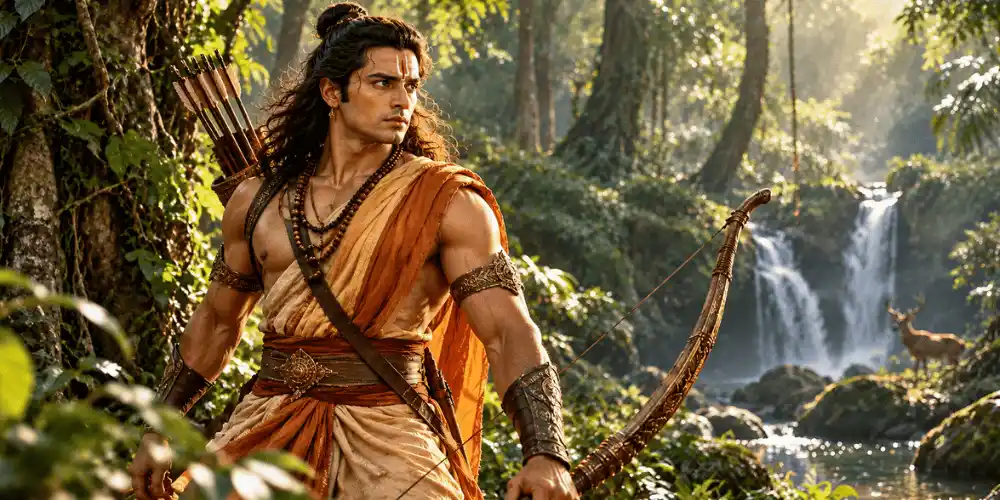
Sumitra received two helpings of payasam. Therefore, she gave birth to two sons. According to tradition, the four brothers were related to God Vishnu: Ram Ji was an avatar of Vishnu Ji, and Lakshman was an incarnation of Shesha, the large snake that Vishnu lies upon. This seems to be a perfect symbolic relationship. Shesha provides support for Vishnu, and Lakshman provides support for Ram Ji throughout his entire life.
The four brothers were also drawn together in natural pairs during their growing years. Ram Ji and Lakshman developed a bond that would never be broken. Bharata and Shatrughna formed a similar relationship. There are many stories about how much Lakshman hated being away from Ram, even at an early age.
The Early Years: Vishwamitra, the Bow and the Marriage
Lakshman gets involved in a major adventure for the first time after Vishwamitra comes to Ayodhya and requests that King Dasharatha allow Ram to go with him so that he can protect Vishwamitra’s ritual from being interrupted by demons. Lakshman accompanies Ram, and the two brothers are able to defeat the demoness Tataka, as well as several other dangers on their way. Since this occurs relatively early in the story, it will most likely be part of Part 1 in the Ramayana film.
Mithila is next, which is the home of King Janaka and the location of Sita’s swayamvara. To gain Sita’s hand, Rama lifted and broke Shiva’s massive bow. Following this, there were several other family weddings, including Lakshman marrying Urmila, Sita’s younger sister. Please remember her name, as she will become one of the most quietly heartbreaking characters throughout the entire epic.
The Exile: Where Lakshman Becomes Lakshman
The day before Ram Ji was to be crowned King, Queen Kaikeyi (who had been swayed by her maid, Manthara) requested that King Dasharatha fulfill two previously made promises. These were: to make Bharata King, and to banish Ram to the forest for fourteen years.
The true nature of Lakshman’s character comes through here. Lakshman is extremely angry. In the traditional version, Lakshman is prepared to fight, to challenge his father’s decision, and to use force to claim the throne for Ram Ji. It is Ram who calms Lakshman, telling Lakshman that once a king makes a promise, it must be fulfilled.
This is the moment I am most affected by. When Ram Ji asks Lakshman to stay behind and care for their mothers, Lakshman does not agree. Instead, he tells Ram Ji that he will accompany him. To Lakshman, serving Ram Ji is an inherent part of his identity, not something that can be negotiated.
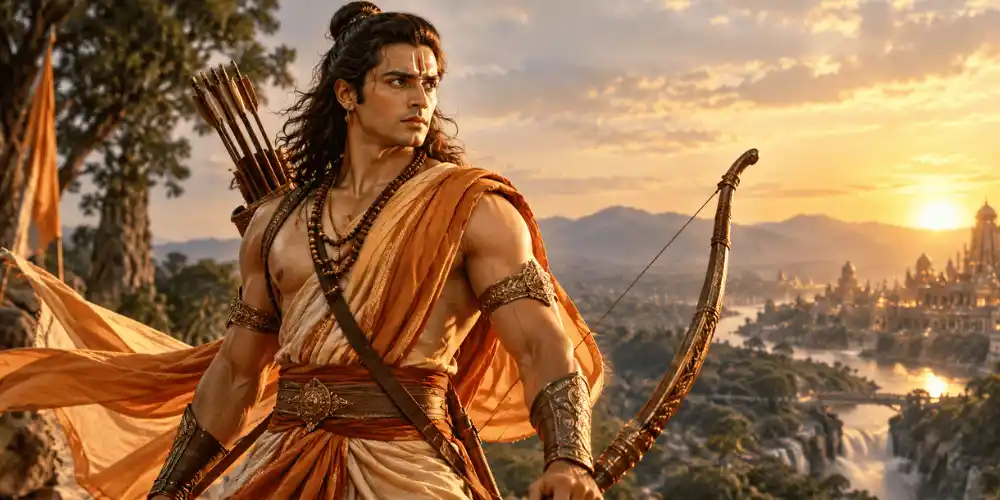
Sumitra, Lakshman’s mother, gives her approval of his decision by giving him a very well-known piece of advice, which translates into: “Treat Ram as you would treat Dasharatha, treat Sita as you would treat me, and treat the forest as you would treat Ayodhya.”
When Lakshman had the opportunity to make a true decision for himself for the first time, he chose to give up all of the things he enjoyed about being a prince – including his home, his family, and his position in society – to serve others. This was the basis for everything he did after this.
Fourteen Years in the Forest: Service, Anger and Sleeplessness
Lakshman has the responsibility of performing the daily tasks during the period of their exile. He is responsible for building the hut in Panchavati, guarding it during the night, gathering food, and keeping an eye on both Ram Ji and Sita Maa.
There is a well-known story that states Lakshman promised not to sleep for the entire 14 years so that he would be able to protect both Ram Ji and Sita Maa without any interruption.
The legend is also accompanied by a lovely backstory. According to many versions of the tale, Nidra (the Goddess of Sleep) was able to approach Lakshman, and he requested her to pass his allotted sleep time to another individual. Nidra agreed, provided someone was willing to accept the offer.
Urmila accepted, and spent the next fourteen years sleeping in Ayodhya, while Lakshman remained awake in the forest. Although this particular event does not appear in the oldest Sanskrit versions of the Ramayana, but rather in later regional versions, it has been embraced as one of the most popular elements of the legend.
A great example of Lakshman’s loyalty to Ram Ji occurred after Sita Maa was taken by Ravana. When Ram and Lakshman found Sita’s jewelry on the ground, Ram asked Lakshman if he recognized the jewelry. Lakshman replied that he could not recognize the necklace or earrings as he had never seen anything other than her feet; however, he could recognize her anklets. This statement illustrates clearly how Lakshman behaved toward Sita: with respect, humility, and absolute control.
The Shurpanakha Episode and the Golden Deer
The two events in the forest were the beginning of the tragedy, and Lakshman had a role in both of them.
Shurpanakha is the first to be involved. She loves Ram, but he says no. So she goes to Lakshman and tells him she loves him too. Lakshman also says no. Then Shurpanakha threatens Sita Maa, and Lakshman cuts off Shurpanakha’s nose. This causes Shurpanakha to go see Ravan, and this begins the war. The movie stars Rakul Preet Singh as Shurpanakha, so you can count on seeing that part of the movie.
The second involves the golden deer. Sita Maa sees a very pretty golden deer (which is really the demon Maricha) and requests Ram Ji to hunt down this deer. He does so but instructs Lakshman to watch over Sita.
Suddenly, there is a cry for help heard from what sounds like Ram Ji voice. Sita Maa gets scared and urges Lakshman to go to Ram Ji. He initially refuses because of Ram Ji orders; however, he eventually gives in to Sita Maa’s pressure and leaves.
Most of us know what follows as the Lakshman Rekha, the protective boundary he creates around the hut and asks Sita Maa not to cross. One thing you should realize about this famous line: it does not exist in the original Sanskrit version, the Valmiki Ramayana. It was added to later versions of the story and was so well-received by audiences that the term Lakshman Rekha has become a common expression for a line that can never be crossed. Whether the film portrays the Lakshman Rekha or not, the line has become a significant aspect of how the story is remembered today.
As soon as Lakshman leaves, Ravan appears disguised as a holy man. Sita Maa comes outside to give some food to the holy man, but instead of receiving the food, Ravan abducts Sita Maa.
The Search, the Alliance and The War
After Sita Maa is abducted by Ravan, Ram Ji and Lakshmana start to search for her. They find the dying vulture Jatayu, who was trying to prevent Ravana from taking Sita. Then, they encounter the devoted Shabari. Finally, they arrive at Kishkindha and become allies with the vanara king Sugriva and Hanuman.
Lakshman has another opportunity to display his anger. After Sugriva, recently made king and very satisfied with himself, does not immediately begin to fulfill his commitment to assist, Lakshman enters Kishkindha mad. It is Tara, Sugriva’s wife, who calms him down, and then Sugriva begins to do what he promised. This incident shows us that Lakshman is much more than a quiet, submissive sibling. He has a lot of passion within him.
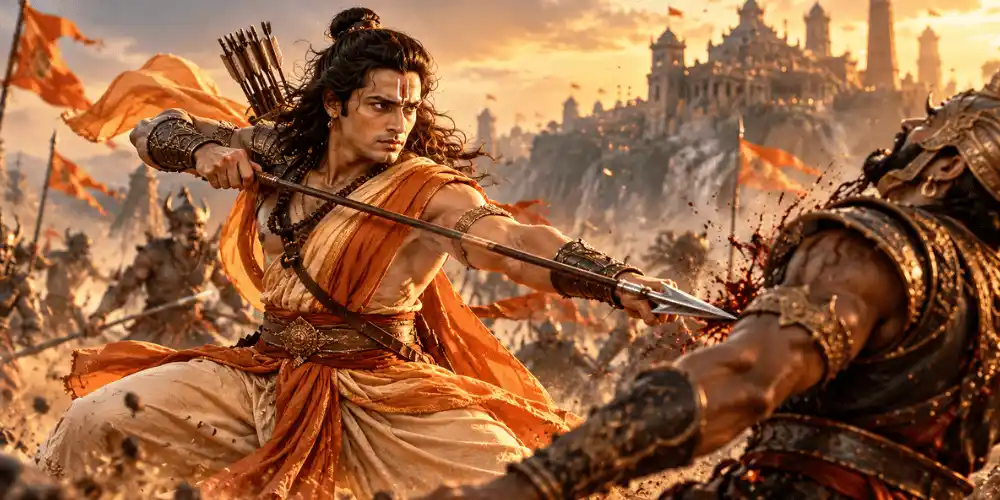
During the war in Lanka, Lakshman transforms into a genuine warrior. The most formidable adversary he faces is Indrajit (or Meghnad), the son of Ravan. Indrajit is one of the most perilous warriors within the entire epic. He is an expert at creating illusions and wielding divine weaponry. He almost annihilates the Vanara army and slays both brothers.
In one of the most famous versions of the story, Lakshman is badly injured in battle. He loses consciousness, and the physician Sushena states that only a rare herb found in the Himalayas will be able to heal him. Hanuman Ji goes to the Himalayas to find this herb, but because he cannot determine which herb is the correct one, he carries the entire mountain back with him.
Lakshman recovers. This is a classic scene, and since Sunny Deol was chosen to portray Hanuman Ji, it would make sense if this scene became a highlight of the next movie, or perhaps even a later installment in the series.
In the end, Lakshman kills Indrajit. According to tradition, Indrajit was given a blessing which meant that only someone who had been awake continuously for 14 years would be able to kill him. This makes Lakshman the only candidate to fulfill this requirement. At this point, the sleepless vow is no longer merely an act of devotion. It has become the turning point in the war.
After the War: The Quiet, Painful Ending
Lakshman’s death is also a sad one. According to some accounts, Time/Death, disguised as a wise man, approaches Ram Ji asking for a private meeting. Time/Death says that anyone who interrupts the meeting will be killed or sent into exile. Ram Ji tells Lakshman to watch the door. Durvasa, a very angry wise man, comes to the door wanting to meet with Ram Ji right away. Durvasa threatens to curse Ram Ji if he doesn’t meet with him. Lakshman has a decision to make. Does he protect the people of the country or follow Ram’s orders?
Lakshman decides to break Ram’s rules. Ram Ji is forced to banish Lakshman because of his promise. Lakshman goes to the Sarayu River and kills himself, and returns to his original form of Shesha.
This was a quiet, sad way to die for a person who had always remained at his brother’s side throughout his entire existence.
Ravi Dubey as Lakshman
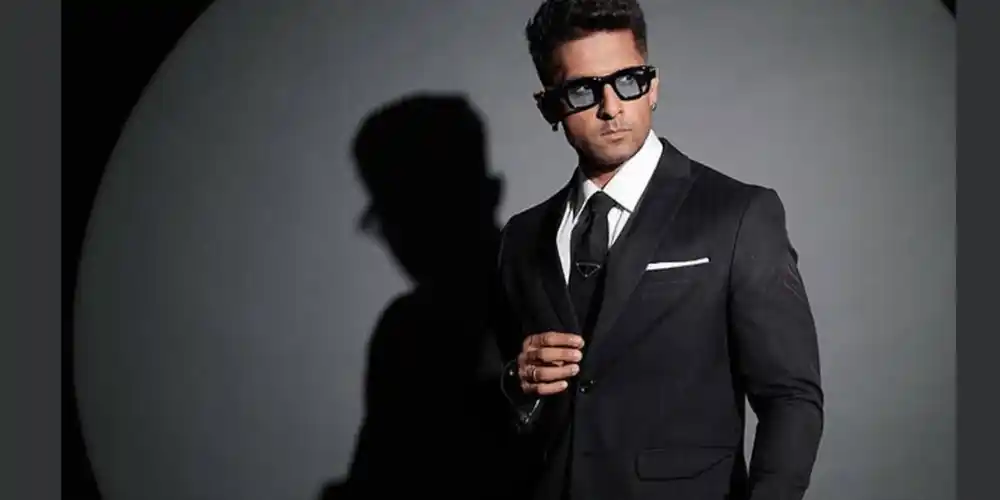
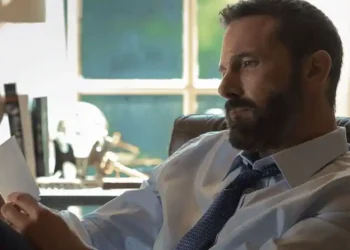
Ravi Dubey is playing the role of Lakshman in Ramayana and is best known for Hindi television and the series Jamaai Raja. He has spoken about how personal the role feels, even sharing a story about unknowingly visiting a Lakshman temple in Lucknow nearly a year before he was confirmed for the part. Early reactions to the film itself have been mixed, with social media responses to the trailer divided. I’d go in with an open mind and judge the film on how it handles the characters.